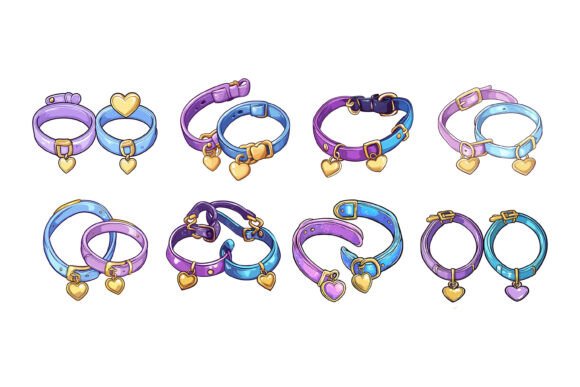
A Set of Collars for Cats and Dogs Illustrations
Every creative project benefits from visual elements that feel intentional, polished, and easy to adapt. Whether you are designing a promotional flyer for a pet adoption event, building an e‑commerce site for handmade accessories, or creating an infographic about pet safety, the small details often make the biggest difference. A set of collars for cats and dogs, delivered as meticulously organized vector artwork, can provide exactly the kind of foundational graphic that saves hours of drawing from scratch while keeping the final output looking professional.
What arrives inside the download is not simply a single image. This special collection from our AI EPS library includes multiple collar styles suited for both feline and canine designs, all presented in formats that bridge the gap between high-end print demands and everyday digital use. The file package provides an Adobe Illustrator AI file, a fully compatible EPS version, and a high-resolution JPG for quick previews or immediate placement. This trio of formats means you can open the artwork on a Mac or a Windows machine without worrying about compatibility hurdles, and you can hand off the files to a print vendor knowing they will have exactly what they need.
Why a Well‑Structured Vector Set Matters
The practical value of an illustration set often lives in its internal organization. Nobody wants to spend thirty minutes hunting through dozens of unnamed layers or trying to isolate a single element that has been flattened into an uneditable shape. In this collection, every collar sits on its own neatly labeled layer, with components grouped logically. This disciplined file and layer structure means you can quickly locate the buckle, the strap, the stitching details, or any decorative elements and modify them independently.
For a graphic designer juggling multiple client projects, that organization translates into fewer clicks and a smoother editing flow. A small business owner who needs to match a collar graphic to an existing brand palette can open the AI file, select the portion they need, and apply a new color in seconds. No unwieldy clipping masks, no mysterious grouped objects. The consistency across every collar variant—identical stroke weights, aligned anchor points, and attention to proportion—ensures that when you place two or three styles side by side in a brochure, they look like they belong to the same visual family. That kind of coherence is not always easy to achieve with free, disparate clip art downloads.
Editing Freedom That Adapts to Your Needs
One of the quiet frustrations of using stock graphics is discovering that a supposedly editable asset is actually a flattened raster sitting inside a vector container. The AI and EPS files in this set are built as genuine scalable vectors from the start. Because every line and fill is a live shape or path, you can change colors, adjust line thickness, rearrange components, or even combine elements to create an entirely new collar design. The flexibility extends far beyond color swaps. If you need an engraved nameplate effect for a custom pet boutique logo, you can pull apart the buckle, resize the tag area, and drop in your own typography without losing any sharpness.
This level of editability also means you can convert the artwork into icon sets for mobile apps. By simplifying the detail level and exporting at various pixel sizes, the same collar that looked rich in a printed catalog becomes a clean, recognizable icon in a pet‑tracking application. Similarly, you can repurpose the line art for instructional diagrams or infographics that show how to fit a harness correctly. The presence of a JPG preview file makes it easy to scan through the collection and pick the right base design before you even launch Illustrator, which is a small but real speed improvement in a busy workflow.
From Print to Pixels: Multi‑Format Reliability
Professionals who work across different media types understand that an asset created solely for digital screens can fall apart when sent to a commercial printer. The vector nature of this collar set eliminates that worry. You can scale the artwork to the size of a billboard or shrink it to a tiny website badge without a hint of jagged edges. The files are prepared in CMYK color compatibility while also behaving correctly in RGB mode, so a vibrant web graphic does not suddenly look muddied on a printed postcard. That dual readiness is especially useful for marketing teams who run seasonal campaigns and need to reuse the same visual assets across Instagram posts, email newsletters, and physical window displays.
Small publishers and pet bloggers can also tap into this versatility. A blog post about the best breakaway collars for indoor cats gains immediate visual authority when it includes a clear, well‑drawn illustration rather than a generic photo. Because the collar images are consistent in style, you can create a matching series of graphics that tie together a multi‑part article or a downloadable guide. The file structure lets you export at precisely the resolution your content management system requires, whether that is a 72‑pixel thumbnail or a 300‑dpi print‑ready PDF.
Who Finds the Most Value in These Assets
The audience for a carefully compiled vector illustration set is surprisingly broad. E‑commerce store owners who sell pet products can browse the collar designs, pick a style that resembles their own merchandise, and customize the colors and material textures to create on‑brand product listing images. A veterinary clinic might use a simplified version of a collar as a repeating pattern on a welcome brochure, reinforcing a warm, animal‑caring atmosphere without overwhelming the page. Freelance UI designers building a pet‑sitting app need a set of consistent, scalable icons that communicate “pet gear” at a glance, and a collection of collars serves as an immediate, recognizable visual shorthand.
Educators and non‑profit organizers also find concrete uses. A community group planning a responsible pet ownership workshop can incorporate the illustrations into handouts and presentation slides. Because the files are editable, they can add labels, arrows, and safety tips directly onto the graphics without needing a separate design step. Even hobbyists who create custom pet memorial keepsakes or handmade scrapbooks can print the collars as embellishments, confident that the lines will stay crisp at any size.
Accessibility is another advantage. The files open in a broad range of vector editing software, not just Adobe Illustrator. Users who rely on Affinity Designer, CorelDRAW, Inkscape, or even older versions of design programs will find the EPS format particularly forgiving. The cross‑platform design, explicitly tested for both Mac and Windows environments, quietly removes a technical obstacle that often frustrates cross‑functional teams.
The Real‑World Impact of Consistency and Detail
Consistency across a design project creates trust. When a visitor lands on a pet‑themed website and sees that every decorative graphic, from the navigation icons to the footer badges, shares the same line quality and proportional logic, they subconsciously perceive the brand as more credible and professional. A set of collars for cats and dogs that maintains identical stroke styles, rounding radii, and negative space treatment across all variants provides that consistency out of the box. You do not need to manually retouch one collar to match another because the designer who built the set applied the same meticulous standards to each piece.
Attention to detail shows up in unexpected ways. The angle of a buckle, the slight curve of a leather‑like strap, the precise placement of a rivet—these small decisions mean that the graphic reads correctly even when viewed at a tiny favicon size. For infographics that compare collar types, this fidelity helps viewers immediately distinguish a martingale collar from a flat buckle collar without reading a caption. It is the type of thoughtful visual hierarchy that turns a good layout into a great one.
For those who create printed materials, the detail extends to how the files handle spot colors and overprint settings. Because the AI and EPS formats retain vector information, a print‑savvy user can prepare the artwork for specialty finishes, such as foil stamping or embossing, by isolating the relevant paths. This may be a niche use case, but it matters deeply to boutique pet accessory brands that invest in premium packaging.
How the Special AI EPS Collections Elevate Daily Work
The “Hello Welcome” collection that brings this collar set together is built around a simple premise: give creatives files that are ready to work, not files that require an hour of cleaning. Every download is designed to drop directly into an existing project with minimal friction. The organized layer panels, descriptive file names, and bundled JPG previews are not afterthoughts—they reflect a workflow that understands how real professionals, educators, and small business owners consume design resources.
One practical scenario: a marketer is preparing a series of social media ads for a pet adoption drive. They have limited time and must produce multiple graphic variations. By opening the AI file of a cat collar illustration and duplicating the artboard, they can quickly generate color versions that match the palette of each partner shelter. The entire process, from idea to export, might take minutes instead of the hours that would be required to search for, license, and clean up multiple separate images. That speed does not sacrifice originality, because the final look is entirely under the user’s control.
It is also worth noting that while the flexibility is extensive, users who do not have a basic vector editing program might find the AI and EPS formats less immediately useful than the JPG. The illustration set shines brightest in the hands of someone comfortable with tools like Illustrator, Affinity, or Corel. For everyone else, the high‑resolution JPG still offers a beautiful starting point for simple layouts in programs like Canva, Word, or PowerPoint, though the deep editability will remain untapped. This is not a shortcoming so much as a fit consideration—purchasing a purely raster image set might be more appropriate if editing is never part of the plan.
Meaningful Outcomes Beyond the Screen
The strongest designs often do their work quietly. A well‑placed collar graphic on an adoption certificate can make the moment feel more special for a new pet owner. A crystal‑clear icon of a quick‑release collar can help a first‑time dog owner understand a training guide more quickly. These outcomes are not abstract; they are the direct result of having a clear, adaptable visual vocabulary at your fingertips. When you have a set of collars for cats and dogs that you trust to print cleanly, scale smoothly, and edit without frustration, you stop seeing the graphic as an asset to manage and start seeing it as a tool to communicate something meaningful.
For entrepreneurs and small business owners, that tool can reduce the cost of hiring a custom illustrator for every small project. For content creators, it can provide a signature visual thread that ties together disparate types of content. For educators, it can turn dry instructional text into something that engages and informs. The value lies less in the files themselves and more in what those files enable you to produce—faster, with greater consistency, and with a polish that reflects well on your work.