Camper, Tent, Forest, Trees: Versatile Outdoor Illustrations
When a design project calls for a touch of the outdoors, few themes capture a sense of adventure and calm as effectively as camping, woodland scenery, and nature-inspired imagery. A well-crafted illustration of a camper van parked among tall trees or a tent glowing under a starry sky can instantly tell a story. Titled “Hello Welcome to our Special AI EPS Collections,” this particular set of vector illustrations brings together these beloved elements—camper, tent, forest, trees, and more—in a format built for practical, everyday creative work. It’s not just a handful of clipart; it’s a thoughtfully organized toolkit that adapts to both professional designers and anyone who wants to elevate a visual project without starting from scratch.
Why Outdoor-Themed Illustrations Matter in Visual Projects
Nature-based graphics have moved far beyond travel brochures. Today they show up in app interfaces, environmental infographics, lifestyle blog headers, and even corporate sustainability reports. Camper and tent motifs appeal to a broad audience—from weekend explorers to families planning their first camping trip. Forest and tree imagery signals freshness, growth, and escape, making it a safe yet evocative choice for brands that want to feel approachable. Because these symbols are universally recognized, they reduce the cognitive load on viewers: one glance at a tent silhouette inside a forest circle and the message of outdoor recreation or eco-friendliness lands instantly. For creators, having access to a cohesive set of such icons means you spend less time hunting for matching styles and more time refining the overall composition.
What’s Included in This AI EPS Illustration Collection
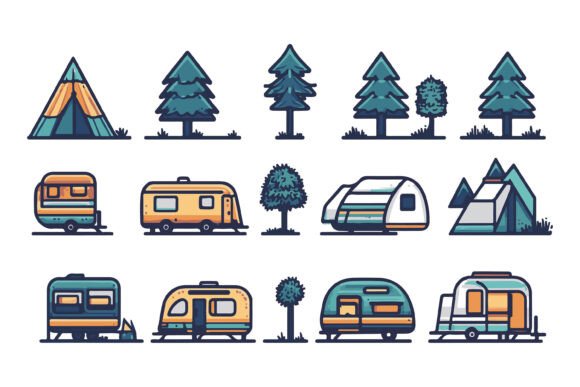
The set focuses on a camper, a tent, forest scenes, individual trees, and complementary elements that round out a wilderness narrative. Rather than offering a single scene, it gives you the building blocks to assemble your own layouts. File delivery includes the industry-standard vector formats AI and EPS, alongside a high-resolution JPG version for quick placement. The vector files are resolution-independent, which means a camper icon that looks crisp on a business card will remain equally sharp on a trade show banner. Whether you’re on a Mac or Windows machine, the assets are fully compatible, eliminating those frustrating moments when a font or shape breaks because of operating system differences.
The Practical Edge: Layers, Organization, and Easy Customization
One of the most overlooked features in stock illustration packs is file architecture. This collection prioritizes a neatly organized layer structure right out of the box. Each element—camper, tent, tree, background foliage—sits on its own named layer, grouped logically. For a designer working under a deadline, that means you can isolate the tent, change its color to match a brand palette, and adjust its stroke weight without disturbing the forest layer beneath it. Small business owners creating a flyer for a camping gear sale can take the camper graphic, recolor it to match their logo, and export it in minutes. The consistency of details across all components also helps: tree bark textures, tent stitching lines, and window reflections share a similar level of refinement, so your final composition feels hand-crafted rather than stitched together from mismatched sources.
Because the artwork is vector-based, scaling up or down never introduces blur. You can turn a small tree icon into a hero image or shrink the entire campsite scene into a tiny app button. The files were prepared with both print and digital outputs in mind, so colors remain vibrant in CMYK for brochures and in RGB for social media posts. For infographic creators, this flexibility is a quiet game-changer: you can drop the tree illustration into a data visualization about forest coverage, resize it to fit the chart’s scale, and know it will print perfectly in a report.
From Web Graphics to Print: Smooth Scalability and Consistent Quality
Suitability across media is a key strength. The same tent illustration that anchors a website’s “adventure tours” landing page can be printed on a canvas tote bag or used in a mobile app’s onboarding screens. Because the EPS and AI files maintain their vector integrity, you avoid the pixelation that plagues bitmap images when they’re stretched beyond their intended dimensions. The set’s attention to detail—soft gradients where morning light hits the camper, delicate branches that don’t become messy when scaled—means the artwork holds up under scrutiny. Designers who frequently move between web layouts, presentation slides, and print collateral will appreciate not having to swap assets for different resolutions. The JPG version serves as a handy placeholder or a quick insert for a blog post, but the real power lies in the editable source files.
Who Benefits Most from This Set?
The audience spans several groups, each with distinct needs.
- Graphic designers and freelancers working on branding for outdoor gear companies, summer camps, or eco-tourism startups can populate mood boards and deliver polished client work faster. The consistent style reduces the need to illustrate every element from scratch.
- Content creators and bloggers who write about travel, hiking, or family camping can enliven articles and social media posts. Instead of relying on generic stock photos, they can craft custom-feeling featured images that stand out in a crowded feed.
- Small business owners run shops that sell handmade tents, campervan accessories, or nature-inspired products. They can personalize product tags, website banners, and e-newsletters without hiring a designer for every update.
- Educators and workshop facilitators create nature lesson plans, outdoor event flyers, or environmental science infographics. The editable graphics let them tailor visuals to specific age groups or themes—swap a deciduous tree for a pine, for instance, to match a regional biome.
- App and web developers who need recognizable symbols for navigation menus, category icons, or onboarding illustrations can integrate these assets directly. The clean lines and consistent stroke widths work well at small icon sizes.
Anyone with a basic understanding of vector software can open these files and start customizing. Even users new to Illustrator will find the organized layers reduce the learning curve; they can click on the “tent” layer and change its fill color without touching anything else.
Real-World Use Cases: Bringing Forest Scenes to Life
Imagine a travel blog covering national park road trips. The author needs a header image for an article about the best campervan routes. By combining the camper, several trees, and a forest background from this set, they can assemble a scene that feels authentic to the story. Because colors are editable, they can shift the camper’s body to match the vintage vehicle they drove, adding a personal touch that resonates with readers.
A mobile app designed to help people find nearby campsites could use the tent icon as its core symbol. The developer simply opens the EPS file, tweaks the color to fit the app’s dark mode palette, and exports at multiple resolutions for iOS and Android. The uniformity of the line art ensures the icon looks like part of a thoughtfully designed family, not a last-minute addition.
For an environmental nonprofit, an infographic about deforestation needs clear, non-distracting tree illustrations. The set’s tree and forest components can be laid out to show a before-and-after comparison. The layer structure lets them duplicate, resize, and rearrange trees into groups, then recolor them to indicate healthy versus logged areas. What would have taken hours to draw can be assembled in a fraction of the time.
Print projects benefit too. A summer camp flyer might place a tent under a cluster of trees as the main visual. A local outdoor store could print a window decal featuring the camper and pines to announce a seasonal sale. Because the files are set up for both Mac and Windows, a team can collaborate without format headaches.
Tips for Customizing the Camper, Tent, and Tree Illustrations
Getting the most from this collection often comes down to a few smart workflows. Start by opening the AI or EPS file in your preferred vector editor. Before making changes, duplicate the original artboard or save a copy, so you always have the base version to return to. Use global color swatches to quickly apply brand colors across multiple elements—recolor the camper, the tent fly, and a few tree highlights in one go. If you need a silhouette version for a bold poster, select the shapes and convert them to a single solid color. For a more playful twist, scale certain elements disproportionately: a giant tent next to tiny trees can create a whimsical children’s book illustration. Because the layer naming is descriptive, you can easily turn off the forest background and use only the camper and tent for a minimalist logo concept.
Things to Keep in Mind Before Getting Started
While the collection is designed for effortless editing, it does assume you have access to vector editing software such as Adobe Illustrator, CorelDRAW, Affinity Designer, or a free alternative like Inkscape. The JPG file is a convenient fallback, but it won’t allow the same depth of customization. If your workflow relies entirely on raster-based tools, you’ll be limited to basic cropping and color overlays. In such cases, you might still find the JPG useful for quick mockups or social media posts, but the full creative potential lies in the vector files.
Another consideration is the artistic style. The set’s details and consistency are one of its main selling points, but if your project demands a radically different illustration language—say, ultra-minimalist line art or hyper-realistic 3D renders—this collection may serve better as a starting reference rather than a final asset. It’s also worth noting that while the set includes a camper, tent, forest, trees, and similar outdoor elements, it doesn’t claim to be an exhaustive wilderness library. If you need highly specific items like a particular model of camping stove or a certain species of oak leaf, you may need to supplement with additional resources. That said, for the majority of outdoor-themed visual stories, the included components cover a wide enough range to form the backbone of your project.
Professionals who regularly prepare client presentations will find the neat organization saves hours of cleanup. Instead of receiving a single flat JPG with everything merged, you get editable masterpieces that can be disassembled and recombined. This aligns with a modern design workflow where speed and adaptability matter as much as original artistry. The fact that the files work across operating systems further removes friction—no more converting fonts or dealing with missing link warnings when opening a colleague’s file.
In a market flooded with generic clipart, a thoughtfully constructed outdoor illustration set that includes a camper, a tent, a layered forest, and individual trees fills a specific niche. It supports the creator who wants to infuse warmth and context into a project without spending days on illustration. By balancing editability, consistency, and multi-format delivery, this AI EPS collection fits neatly into the toolkits of marketers, educators, app builders, and hobbyists alike. The versatility to go from a detailed web graphic to a crisp printed poster, with the freedom to recolor and reshape every element, turns a simple pack of illustrations into a genuine creative time-saver.