The Enduring Charm of Retro TV Icons: Why Vintage Design Still Captivates Modern Audiences
There is something undeniably magnetic about the warm glow of a vintage television set, even when reduced to the simplest graphic form. Retro TV icons have become a staple in modern design, bridging the gap between nostalgic sentimentality and contemporary minimalism. Whether you are building a streaming platform, designing an app interface, or crafting eye-catching social media graphics, these iconic symbols carry a universal visual language that audiences instantly recognize and connect with. In an era dominated by sleek, futuristic aesthetics, the return to retro-inspired iconography tells us something important about how we value memory, media history, and the comforting familiarity of analog technology.
This article explores the world of retro TV icons from the ground up, examining their cultural significance, practical applications, and the key features that make a high-quality icon set indispensable for modern creative work. By the end, you will understand not just why these icons matter, but how choosing the right set can elevate your next project across websites, mobile apps, books, social media, infographics, flyers, print materials, banners, posters, and beyond.
The Cultural Resonance of the Television Icon
Before diving into the technical aspects of icon design, it is worth pausing to appreciate why a simple television shape carries so much weight. The television set was, for decades, the centerpiece of the living room. It was the portal through which families gathered to watch historic broadcasts, beloved shows, and breaking news. The physical object itself — with its boxy frame, antennae, dials, and rounded screen — became a visual shorthand for entertainment, connection, and shared cultural moments.
Even younger generations who never used a cathode-ray tube television understand the retro TV silhouette intuitively. This is because the icon has transcended its original hardware to become a symbol of media consumption itself. Streaming apps use it. YouTube creators reference it. Podcast cover art leans on it. The retro TV icon is no longer about old technology; it is about storytelling, broadcasting, and the act of watching. This makes it exceptionally versatile for designers working across industries.
What Makes a High-Quality Icon Set
Not all icon sets are created equal. When you browse through available options, certain features distinguish professional-grade resources from amateur alternatives. A set of high-quality icons suitable for any project must meet several critical criteria. Understanding these will help you make informed choices and avoid the frustration of downloading icons that fall apart when scaled, edited, or integrated into your workflow.
Line and Solid Style Versatility
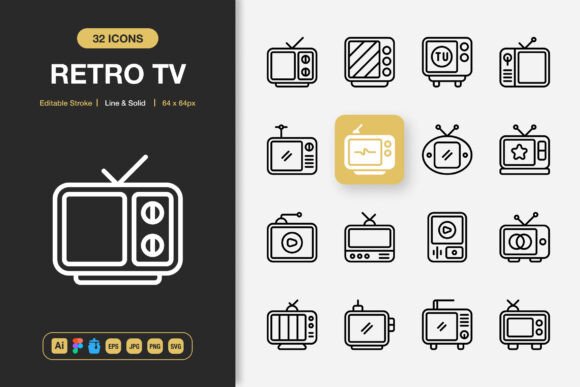
One of the most valuable features in any comprehensive icon set is the inclusion of both line and solid styles. Line icons, with their thin, elegant strokes, convey a sense of lightness and modernity. They work beautifully in minimalist interfaces, editorial layouts, and situations where the icon needs to complement rather than dominate the surrounding content. Solid icons, on the other hand, carry more visual weight. They are assertive, highly visible at small sizes, and ideal for navigation bars, buttons, and places where clarity cannot be compromised.
Having both styles available within the same icon family ensures visual consistency across your entire project. You might use line-style retro TV icons in a blog post illustration while deploying the solid version in the mobile app toolbar, and everything will feel cohesive because the underlying shapes and proportions remain consistent.
Editable Stroke and Full Customization
A truly professional icon set offers editable stroke capabilities. This means the thickness of the lines is not baked into a static raster image but can be adjusted to match your design system. Perhaps your brand guidelines call for a specific stroke weight. Maybe you need to thicken the lines for better legibility on small screens or thin them out for a more delicate print piece. Editable stroke puts that creative control in your hands.
The promise of being 100% customizable extends beyond stroke adjustment. Colors can be changed to match any brand palette. Individual elements can be isolated, combined, or modified. The retro TV icon that ships with the set might have an antenna, but you can easily remove it for a simpler silhouette if your project demands it. This level of flexibility means a single icon set can serve you across dozens of projects without ever looking repetitive or generic.
Practical Applications Across Diverse Media
The true test of any icon set is how well it performs across the wide range of outputs modern creatives actually produce. A retro TV icon set designed with versatility in mind should integrate seamlessly into:
- Websites — From hero section illustrations to favicon-sized navigation elements, retro TV icons add character to web interfaces without sacrificing usability.
- Mobile Apps — Clear, recognizable icons are essential for app navigation. A vintage TV symbol can elegantly represent video libraries, watch history, or media settings.
- Books and E-books — Chapter headings, margin notes, and instructional diagrams benefit from icons that break up text and guide the reader's eye.
- Social Media — Post templates, story highlights, and profile graphics gain personality when paired with thoughtfully chosen iconography.
- Infographics — Data visualizations about media consumption, screen time, or broadcasting history feel more engaging when accompanied by relevant icons.
- Flyers and Print Materials — Event posters for film screenings, retro parties, or media conferences can use TV icons as instant visual shorthand.
- Banners and Posters — Large-format designs require icons that scale without degradation, making vector-based sets indispensable.
This breadth of application is precisely why designers gravitate toward comprehensive icon collections rather than piecemeal, single-use graphics. The same retro TV icon that anchors a poster design on Tuesday can be recolored and resized for a social media graphic on Wednesday, then exported as a tiny PNG for an email newsletter on Thursday.
Understanding File Formats and Their Purposes
One area where designers — especially those early in their careers — can become confused is in the variety of file formats included with professional icon sets. Each format serves a distinct purpose, and knowing when to use which one will streamline your workflow significantly.
Vector Source Files: AI, EPS, and SVG
The Source File Adobe Illustrator (AI) is the master document from which all other formats are derived. It contains the fully editable vector artwork with layers, stroke settings, and color palettes intact. If you need to make substantial modifications to the icons, this is the file you open first.
The EPS Version 10 file serves a similar purpose but with broader compatibility. While Adobe Illustrator is the industry standard, many professionals use alternative vector editors like CorelDRAW, Affinity Designer, or Inkscape. EPS files ensure that these users can access and edit the artwork without proprietary restrictions.
SVG Files are the workhorses of web and interface design. SVG stands for Scalable Vector Graphics, and these files are written in code that browsers can render natively. They remain crisp at any size, load quickly, and can be styled dynamically with CSS. For websites, mobile apps, and any digital product, SVG is typically the format you will use most frequently.
Raster and Transparency Formats: PNG and JPG
PNG Transparency files are essential when you need a pixel-based image with a transparent background. Unlike JPGs, which always include a background layer, PNGs allow the icon to float cleanly over any color or image. This is critical for logos, watermarks, and layered compositions. When a project brief specifies "transparent background," PNG is almost always what they are asking for.
JPG Files have their place too, particularly when file size is a concern and a background color has already been decided. For quick placement in presentations, draft mockups, or situations where transparency is not needed, JPGs offer a lightweight, universally compatible option.
Design System Files: Figma and Iconjar
The inclusion of a Figma File speaks to the modern collaborative design workflow. Figma has become the dominant interface design tool for many teams, and having icons readily available as components within Figma means designers can drag and drop them into wireframes and high-fidelity mockups without ever leaving the application. This eliminates the friction of importing, converting, and cleaning up external files.
Iconjar File support caters to designers who maintain large icon libraries and need efficient search, preview, and export tools. Iconjar is a dedicated icon management application that lets you browse thousands of icons quickly, filter by tags, and export in multiple formats. If you work with icon sets regularly, having an Iconjar-ready file saves hours of organizational overhead.
The Philosophy of Minimalist Icon Design
Retro TV icons naturally lend themselves to minimalist treatment. The classic television silhouette is already so recognizable that a few well-placed lines suffice to communicate the concept. This aligns with the broader movement toward minimalist icon design that has shaped user interfaces for the past decade.
Minimalism in iconography is not about stripping away character; it is about removing everything that does not serve the core communicative function. When you look at a well-designed retro TV icon, you see only what you need: the screen rectangle, perhaps a simple base or antenna, and the subtle curves that evoke a vintage era. Every additional detail would be noise. This restraint makes the icon more versatile, more readable at small sizes, and more elegant in sophisticated design contexts.
Minimalist icons also age better. Design trends come and go — skeuomorphism, glassmorphism, neumorphism — but clean, simple icons tend to look current regardless of the prevailing aesthetic winds. Investing in a minimalist retro TV icon set means building with materials that will not feel dated in two years.
Integrating Retro TV Icons into Your Next Project
Starting a new design project with a robust icon set fundamentally changes your creative process. Instead of pausing to source or create individual icons as needs arise, you have a comprehensive visual vocabulary ready from the outset. The easy drag and drop workflow promised by well-organized icon sets means you spend more time designing and less time searching.
Imagine you are designing a landing page for a podcast network. You need a play button, a microphone icon, and a retro TV symbol to represent the video podcast section. With a unified icon set, all three are stylistically compatible. They share the same stroke weight, the same corner radius, the same design DNA. The result is a polished, professional page that feels like it was designed by a single hand with a clear vision.
Now imagine the same scenario but with icons pulled from three different free sources. The weights do not match. The proportions feel off. The visual language is inconsistent. The design suffers, and the audience may not consciously notice why, but they will feel that something is slightly unpolished. Consistency in iconography is one of those invisible quality markers that separates amateur work from professional-grade output.
Common Misconceptions About Icon Licensing and Usage
A brief note on usage rights is warranted, as confusion here can lead to design teams making costly mistakes. High-quality commercial icon sets typically come with clear licensing terms detailed in a Readme.txt file. This document explains what you can and cannot do with the icons — whether they can be used in commercial products, whether attribution is required, and whether the icons can be resold or redistributed as standalone assets.
Always read the license file. The inclusion of a Readme is a mark of professionalism from the creator, showing that they have thought through the legal framework and want users to have clarity. It protects both the designer who created the icons and the designers who use them.
Why Retro TV Icons Remain Relevant
We live in a moment of peak nostalgia. Streaming services resurrect shows from decades past. Vinyl records are sold in supermarkets. Analog aesthetics permeate digital spaces. The retro TV icon sits at the intersection of this cultural current and practical design need. It is simultaneously a nostalgic gesture and an efficient communication tool.
For projects that deal with media, entertainment, broadcasting, film criticism, or content creation, the retro TV icon is not just decorative — it is semantically loaded. It tells the audience immediately what category of content they are engaging with. This is the essence of good icon design: doing communicative work without demanding the viewer's conscious attention.
Whether you are a seasoned art director refreshing a brand system or a freelance designer preparing assets for a client presentation, the right set of retro TV icons can change the speed and quality of your output. The combination of line and solid styles, editable stroke, full customization, extensive format support, and compatibility with modern design tools like Figma and Iconjar makes a professional icon set one of the most practical investments you can bring into your creative toolkit.
As you prepare for your next project — be it a website redesign, a mobile app prototype, a printed editorial spread, or a social media campaign — consider how the quiet charm of a well-crafted retro TV icon might anchor your visual language. Sometimes the smallest elements make the biggest difference, and icons, for all their modesty, are the quiet workhorses of great design.