Urban Sport Icons: A Clean, Adaptable Resource for Designers and Creators
Visual consistency across platforms remains one of the most underrated aspects of effective design. When a fitness app, a local basketball tournament flyer, and a streetwear brand’s Instagram story all share a similar design language, the result is subtle but powerful. That’s where a thoughtfully assembled icon set like Urban Sport Icons earns its place. Rather than a generic pack of sports symbols, this collection offers a focused set of graphics built around movement, energy, and the aesthetic of modern city-based athletics. For professionals who need crisp, scalable iconography without spending hours customizing mismatched SVG files, it presents a compelling option.
The value of a good icon set often lies in how quickly it removes friction from a design process. After examining this particular collection across several file formats and use cases, it’s clear that its strengths sit squarely in usability, editability, and presentation quality. The set doesn’t try to cover every sport imaginable. Instead, it concentrates on urban activities—skateboarding, streetball, parkour, fixed-gear cycling, and similar disciplines—and delivers those with a level of polish that makes the icons immediately usable in both digital and print environments.
What’s Inside the Urban Sport Icons Collection
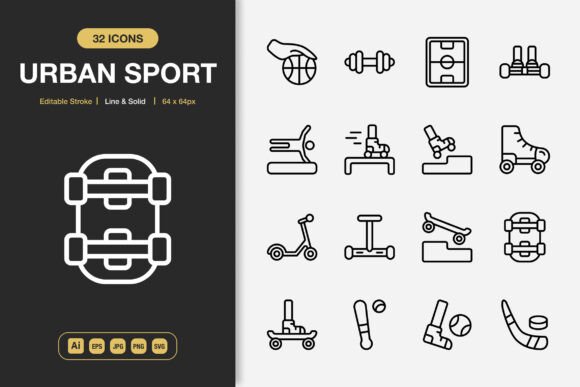
At its core, the package offers a curated mix of icons representing active lifestyles that thrive in concrete landscapes. Think of silhouetted skateboarders mid-trick, basketball players in motion, BMX riders, runners, and boxers. Each symbol is rendered in two distinct styles: a clean line style and a bolder solid style. This dual approach isn’t just a nice-to-have; it drastically increases the range of projects the icons can support. A line icon might feel right for an elegant fitness journal layout, while the solid variation brings authority to a mobile app’s bottom navigation bar.
All source files ship in well-organized folders, with the master Adobe Illustrator file allowing deep edits, an EPS for legacy compatibility, and a PDF for quick review. More importantly for web and UI designers, the package includes SVG files and multiple PNG transparency sizes. The PNGs come at 32px, 48px, 64px, 96px, 128px, 256px, and 512px, covering everything from favicon-sized assets to crisp retina display needs. A Readme.txt file rounds out the package with basic guidance, which is a small but practical addition.
Why Line and Solid Styles Solve Real Design Problems
One of the most frequent pain points in interface and editorial design is finding icon families that maintain visual harmony while offering enough stylistic variation. Urban Sport Icons directly addresses this by providing matched pairs. The line style uses consistent stroke widths—fully editable through the stroke panel—so you can thicken or thin the lines to match your project’s weight requirements without creating awkward inconsistencies. The solid version simplifies recognition at small sizes, where fine lines might disappear on low-resolution screens or in print.
This deliberate stylistic pairing is particularly useful for projects that span multiple touchpoints. A marketing team might use solid icons on bold social media posts while the same brand’s website header opts for the line version. Because the underlying shapes are identical, the visual language stays coherent. That kind of versatility often takes hours of manual adjustment in other sets; here it’s built in from the start.
File Formats and How They Simplify Your Workflow
A large part of evaluating any creative asset comes down to file format support, and this set delivers a comprehensive range. The Adobe Illustrator source file stands as the backbone: you can change colors, adjust the stroke weight of the line style, combine elements, or even extract individual pieces to create entirely new compositions. The EPS version ensures that older software or collaborative environments without the latest Creative Cloud subscription can still open and edit the artwork.
For web and app developers, the SVG files are the most valuable asset. They are lightweight, infinitely scalable, and can be animated or styled with CSS. Having all icons as clean, well-named SVGs means a front-end team can drop them into a project and maintain crisp rendering across any viewport. The PNG transparency files at seven pre-rendered sizes remove any need for resizing in raster-based software, which reduces blurring and anti-aliasing artifacts. The JPG and PDF files further accommodate previews, print-proofing, or integration into office documents.
Quality and Presentation: Beyond Simple Pictograms
Minimalist design demands precision. Poorly drawn icons reveal themselves through uneven curves, awkward negative space, or inconsistent line terminations. Urban Sport Icons holds up well under scrutiny. The shapes feel deliberate, capturing dynamic poses with enough abstraction to remain universally readable. A skateboarder isn’t just a generic person on a board; the posture, the angle of the legs, and the slight tension in the silhouette suggest motion without overcomplicating the form.
From a technical quality standpoint, the vectors are clean, with minimal extraneous points that bloat file sizes. This matters when embedding SVGs in a webpage—leaner code leads to faster page loads and easier maintenance. The PNG exports appear sharp and pixel-aligned at the listed dimensions, which is crucial for UI mockups and social media graphics where sub-pixel blur can erode professionalism. For anyone building a design system or a consistent brand toolkit, this level of craft reduces the time spent fixing small imperfections.
Editing Flexibility and How It Performs Under Real Customization
The promise of “100% customizable” icons often falls flat when you actually try to edit them, but the Illustrator source file here genuinely supports extensive changes. Because the line style is built with stroked paths rather than outlined shapes, you can open the file, select all line icons, and adjust the stroke weight with a single action. You can also round the caps and corners, switch to dashed lines, or recolor everything to match a brand palette in seconds. The solid style offers similar ease for color swaps and resizing without breaking the silhouette integrity.
Drag-and-drop functionality further streamlines the process. Users of Figma, Sketch, or Adobe XD can import the SVGs directly and treat them as components. Since the naming convention is consistent, swapping between the line and solid variants of the same icon is quick. This ease of integration reduces the cognitive load on designers juggling multiple asset sources. In practice, that means a social media manager can pull a basketball icon, resize it for an Instagram Story, and keep the visual impact without ever opening a heavy design tool.
Practical Applications Across Industries and Media
The reach of these icons goes beyond a fitness app. Their urban, active aesthetic fits naturally into a variety of contexts:
- Mobile applications: workout trackers, event discovery platforms, and sports betting interfaces often need athletic iconography that reads well at small sizes. The solid style excels here.
- Websites: landing pages for sports clubs, recreation centers, and urban lifestyle blogs can use the line icons as section dividers or feature highlights.
- Print materials: flyers for streetball tournaments, parkour workshops, or bike-sharing campaigns benefit from scalable vector files that don't degrade when blown up to poster size.
- Social media and infographics: the clean silhouettes work on busy backgrounds, and the PNG transparency ensures the icons play nicely with photo overlays and gradient backgrounds.
- Books and magazines: editorial layouts covering street culture or sports sociology can integrate these unassuming graphics as marginalia or chapter openers.
A real-world example: a small business owner running a calisthenics park might use the solid icons for outdoor signage, the line versions for a mobile-friendly workout guide, and the PNG files for Instagram stories—all from a single purchase. This cross-media flexibility saves money and preserves visual brand language.
Who Gets the Most Value from Urban Sport Icons
Not every icon set fits every audience, and this one caters to a specific but sizable group. Freelance designers and creative entrepreneurs who regularly tackle projects in the sport, fitness, and lifestyle niches will find the collection saves them hours of searching through disparate free icon sites. The consistent quality removes the headache of patching together a set of icons that almost match but never quite do.
Marketing professionals and social media managers at gyms, athletic apparel brands, and event organizations will appreciate the instant drag-and-drop usability. They don't need to learn Illustrator to get professional results. Small business owners such as personal trainers or dance studio operators can use the PNG files to quickly produce flyers, membership cards, and digital ads that look polished without hiring a designer for every asset. For educators and publishers creating visually engaging learning materials or ebooks on physical education, the icons provide a consistent, modern look that appeals to a wide age range.
Larger agencies and in-house design teams will find the source file and extensive format list appealing for systemization. The ability to edit global properties like stroke weight across an entire icon family allows teams to enforce brand guidelines without manual pixel-pushing. The included Readme.txt file, though brief, contains basic instructions that junior designers can follow immediately.
Points Worth Weighing Before You Buy
No resource is perfect for every scenario, and Urban Sport Icons has limitations that some users should consider. The most obvious is its thematic scope. This set is deliberately focused on urban street sports. If your project requires traditional team sports like soccer, baseball, or swimming, you’ll likely need a supplementary pack. The icons also carry a modern, minimalist tone that may not align with a brand that uses a highly illustrative or retro style. While the line weight is editable, the fundamental design language leans toward sleek and contemporary, which can clash with certain visual identities.
Another aspect is the lack of an extensive icon count. This isn’t a 500+ icon mega-bundle; it’s a curated set. For some, that’s a strength because it avoids clutter. For others who need high volume, it might feel limited. Also, the JPG format included is more of a convenience for previews and less useful for actual design work, given the transparent PNGs and vectors are superior. Lastly, while the editable stroke is a powerful feature, novice users unfamiliar with vector editing software might not immediately grasp how to take full advantage of it without a brief tutorial.
Long-Term Value and Integration Into a Design Toolkit
Assets that age well share a few traits: they are technically sound, stylistically relevant but not overly trendy, and adaptable enough to survive brand evolutions. Urban Sport Icons leans on a timeless minimalist approach that doesn’t rely on dated gradients or overcomplicated details. This means the icons will likely remain usable years after purchase, especially because you can recolor and restyle them to match shifting brand guidelines.
The inclusion of SVG and vector source files future-proofs the set for emerging display technologies. As screens continue to increase in resolution and new devices emerge, having resolution-independent graphics means you won’t need to repurchase icons every time a new iPhone or monitor standard arrives. From a cost perspective, the time saved per project—searching, minor editing, testing at different sizes—can offset the initial purchase price within the first few uses, especially for freelancers billing by the hour.
A Sensible Addition for the Right Creative Workflow
Designers who have spent years juggling free icon resources know the quiet frustration of inconsistent outlines, messy code, and poor export options. Urban Sport Icons sidesteps these issues by delivering a thoughtful, well-prepared package that addresses a clear design need. It doesn’t promise the impossible; it simply provides a reliable set of urban sport symbols that look clean at any size, work across major software, and invite customization without resistance.
For those whose work regularly overlaps with street sports, fitness branding, or modern lifestyle content, this collection can become a dependable default. The combination of line and solid styles, the straightforward file structure, and the genuinely editable vectors makes it a practical tool rather than a decorative afterthought. When projects demand fast turnaround and visual coherence, having a single go-to icon family that performs across web, print, and social media is not just a luxury—it’s a quiet competitive advantage.